
Families don't choose a school the way you think they do.
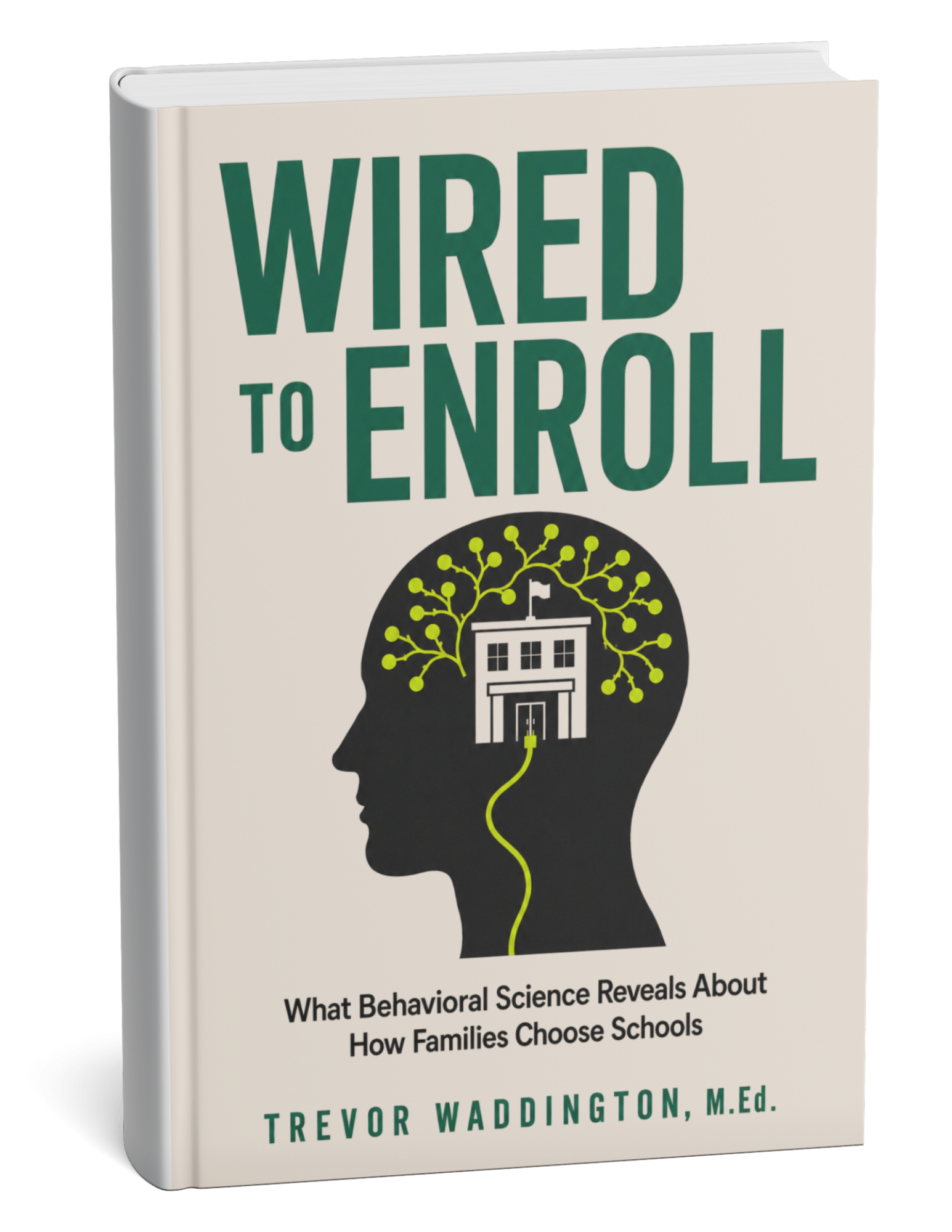
Wired to Enroll: What Behavioral Science Reveals About How Families Choose Schools, a book by Trevor Waddington, founder of Truth Tree.
Buy on AmazonAvailable in Kindle and paperback.
What Wired to Enroll is about
Families say they choose a school for its academics, outcomes, and fit. In practice, the decision runs on mental shortcuts, biases, and emotional triggers that most admission offices never plan for.
Wired to Enroll pulls back the curtain on those patterns and shows admission and marketing teams how to work with them instead of against them. It draws on Trevor Waddington's years as an independent school admission, marketing, and financial aid director, and on Truth Tree's work with more than 200 schools.
It's written for heads of school, admission and enrollment directors, and school marketing teams, including schools whose enrollment is already strong and want to keep it that way.
What's inside
Nine short chapters
About 80 pages on how families find, weigh, and commit to a school, and what that means for your marketing and admission process.
A behavioral science cheat sheet
The principles from the book in one place, ready to use in your next campaign or tour.
A 20-question funnel self-audit
A set of questions your team can use to see where your enrollment funnel works with family psychology and where it works against it.
The four pillars of Enrollment Design™
The book introduces Enrollment Design™, Trevor's framework for applying behavioral science to enrollment. It follows the order in which families actually make up their minds.
Be Discovered
Show up where families start looking, including the short lists AI assistants give parents.
Build Value
Help families understand what makes your school worth the investment.
Earn Trust
Give families the proof and reassurance they need to move forward.
Be Chosen
Make the final decision feel clear, confident, and easy.

About the author
Trevor Waddington, M.Ed., is the founder and principal of Truth Tree, a digital marketing agency that works exclusively with schools and education-based organizations. He began his career in the classroom before moving into leadership roles in school marketing, communications, and enrollment management.
A recognized voice in digital psychology and behavioral economics, Trevor brings a rare perspective on how families consider, evaluate, and ultimately choose a school for their children.
17
Years inside schools
As a teacher, admission and financial aid director, and marketing director.
11
Years leading Truth Tree
Building the team that grounds enrollment marketing in behavioral science.
200+
Schools supported
Reaching right-fit families worldwide through paid and organic search.
“Wired to Enroll is approachable, actionable, and full of practical ideas. In it, Trevor Waddington gives a name to something admission directors usually learn the hard way: the psychology of choice. This book asks whether our schools are optimizing for their own ego or for the hopes and insecurities parents carry for their children.”David LazoFounder and Principal, Journeys Educational Advising
Questions about the book
What is Wired to Enroll about?
Wired to Enroll explains the mental shortcuts, biases, and emotional triggers that drive how families choose a school, and shows admission and marketing teams how to work with those patterns instead of against them.
Who wrote Wired to Enroll?
Trevor Waddington, M.Ed., founder and principal of Truth Tree. He spent 17 years inside independent schools as a teacher, admission and financial aid director, and marketing and communications director, and has led Truth Tree for 11 years.
Who should read it?
Heads of school, admission and enrollment directors, and marketing and communications teams at independent, private, and boarding schools. It is written for schools with strong enrollment that want to stay that way as much as for schools working to grow.
When was it published and where can I buy it?
Wired to Enroll was published in October 2026. It is available on Amazon in Kindle and paperback.
How long is it?
About 80 pages: nine chapters, a behavioral science cheat sheet, and a 20-question self-audit of your enrollment funnel.
What is Enrollment Design™?
Enrollment Design™ is Trevor Waddington's framework for applying behavioral science to school enrollment. It follows four pillars that mirror how families decide: Be Discovered, Build Value, Earn Trust, and Be Chosen.
How does behavioral science apply to school admissions?
Families rarely choose a school through a purely rational checklist. Most think about a school for two years or more before filling out an inquiry form, and they rely on mental shortcuts, social proof, and emotion along the way. Behavioral science explains those patterns so schools can design their marketing and admission process around how families actually decide.